
Visible in the air. Connected on the ground.
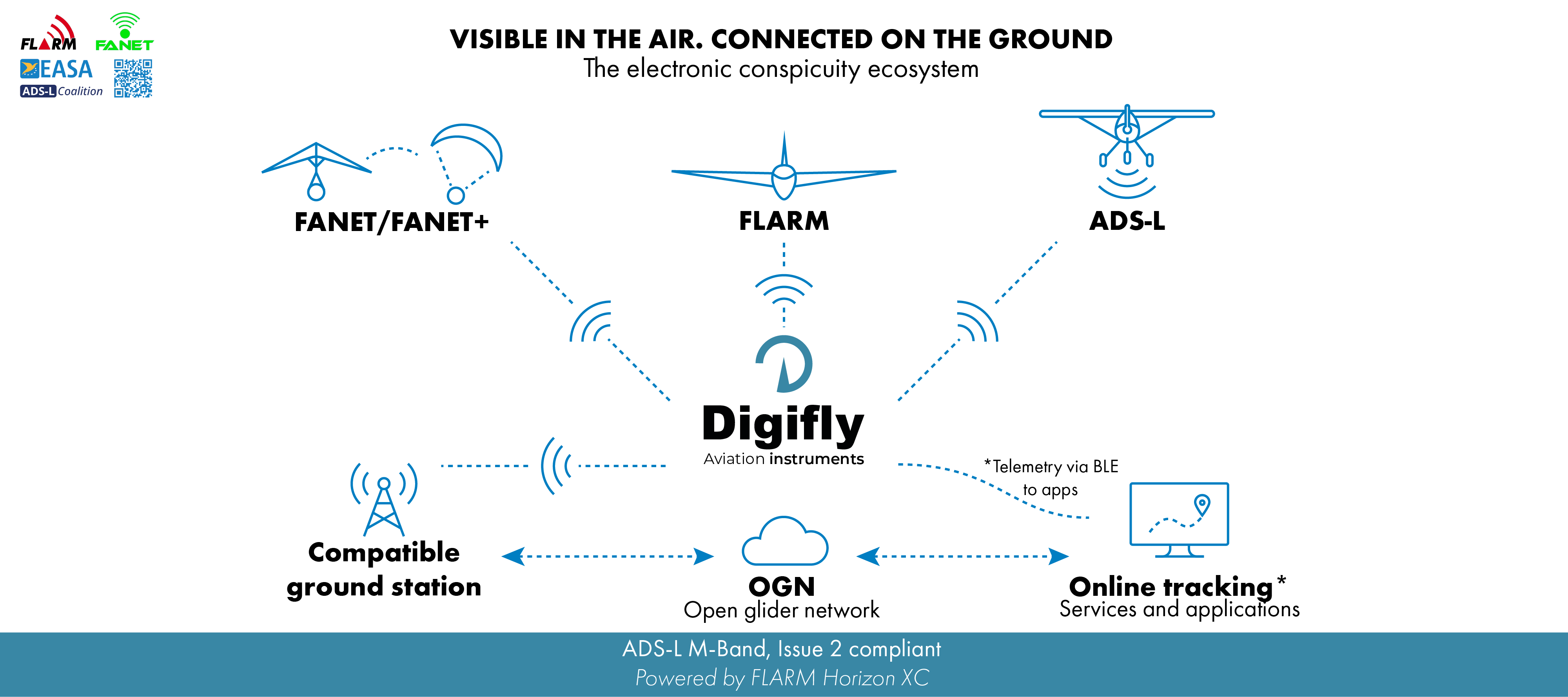
With the FLARM/FANET beacon + ADS-L out module, Digifly AirPRO, PRO Pitot and HG series instruments become part of the electronic conspicuity ecosystem: complementary technologies that share your position with other airspace users equipped with compatible receivers. FANET makes your position detectable by compatible devices within the free-flight community, while FLARM extends this visibility to systems installed in gliders, ultralights and other aircraft. ADS-L Out adds transmission compliant with ADS-L M-Band, Issue 2, contributing to the interoperability promoted by EASA. This approach aligns with Switzerland’s FASST-CH programme, led by the Federal Office of Civil Aviation (FOCA), and the direction outlined by the Swiss Hang Gliding and Paragliding Association SHV/FSVL, which identify ADS-L as a key technology for paraglider and hang glider electronic conspicuity. In the Digifly AirPRO-AirPRO Pitot configuration, the module operates as a beacon transmitting your position to the surrounding traffic.
Connectivity continues on the ground through compatible receiving stations, which can forward position data to the Open Glider Network (OGN) and connected tracking services. A complementary route uses instrument telemetry over Bluetooth Low Energy (BLE) to compatible apps, which can upload data to online services through the smartphone’s Internet connection. The beacon’s radio transmissions do not require cellular coverage; online tracking availability depends on ground-station reception, Internet connectivity and the services used. Electronic conspicuity and online tracking therefore serve complementary purposes, using different infrastructure and operating requirements. Open Glider Network.
The FLARM Horizon XC platform integrated by Digifly supports multiple regional radio profiles. Documented FLARM frequencies are 868.2–868.4 MHz in Europe and Africa, 869.2 MHz in New Zealand, 902–928 MHz in North America, 916.2 MHz in Israel, 922.4 MHz in Japan, and 917–926.6 MHz in Australia and South America. FANET uses separate profiles: 868.2 MHz in Europe, 920.8 MHz in North America and Australia, and 923.2 MHz for the Korea/Asia profile. ADS-L Out M-Band, Issue 2 compliant operation is documented for Europe on 868.2 and 868.4 MHz channels. Availability of individual protocols depends on the regional profile and installed firmware; operation remains subject to the radio regulations of the country of use.
FLARM/FANET beacon + ADS-L out
ADS-L M-Band, Issue 2 compliant
Powered by FLARM Horizon XC